What “memory” means here
Long chat history and vector retrieval can provide useful background, but they do not by themselves identify the current approved decision. Graph Workbench treats reusable memory as organizational state: typed objects, semantic relations, versions and provenance produced through a governed workflow.
The runtime exposes a read-only context query interface to handlers, including Agent handlers. A node can query objects by type and properties, inspect relations or traverse a bounded neighborhood. The Pack still decides what the query means for its domain.
The approval boundary
Only the Pack's context projector promotes selected state. This prevents raw model output, failed work and rejected drafts from becoming trusted memory merely because they appeared in a run.
- Typed: a Release is different from a Review decision or Verification.
- Related: evidence supports a decision; a decision authorizes a release.
- Versioned: later objects can supersede earlier ones without erasing history.
- Attributable: every object retains its producing run, node, actor and source identifiers.
The executable Run A → Run B example
In the bundled Professional Software Delivery Pack, Run A creates an approved Release after parallel verification and two human gates. Run B is a separate deployment-observation graph. It queries the prior Release object, uses its object ID, version and source run while evaluating deployment health, and creates a relation from the new Deployment back to that Release.
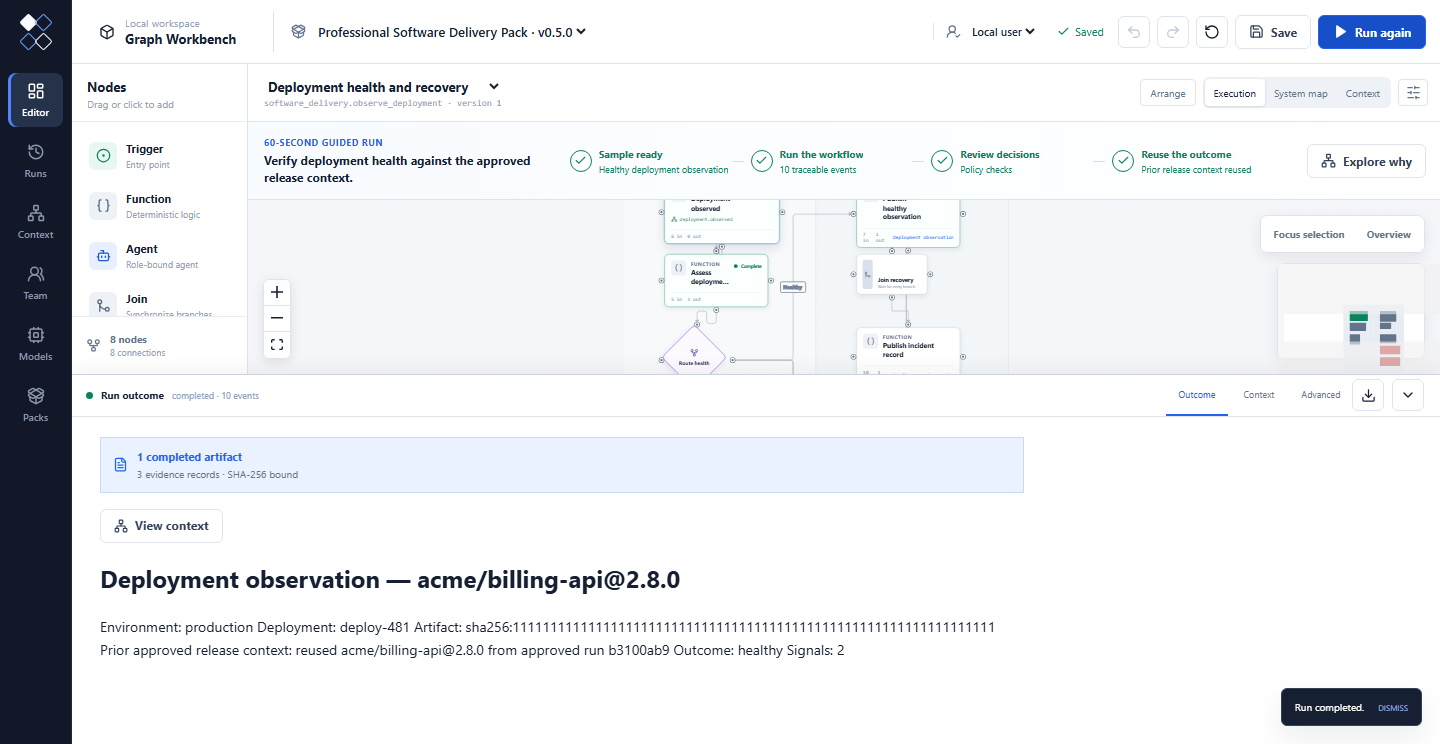
The test suite also proves that relations affect behavior: a later run reports missing support until the required evidence relation exists, then changes its result after the relation is added. Context is therefore executable input rather than a passive history screen.
How this supports multi-Agent collaboration
Agents coordinate through explicit workflow state during a run and through approved context across runs. Each role reads a bounded, typed view instead of sharing an unrestricted scratchpad. Human gates and policy checks remain visible in the execution graph, while the context graph carries the decisions and artifacts that survived them.
This design favors accountable organizational memory over unconstrained autonomous memory. Storage remains an adapter, so teams can use the reference store or connect a production database without changing Pack semantics.